
Which blood pressure number matters more, the top or the bottom
Whichever number is higher decides the range, so 140/70 and 128/92 both sit above the line. What each number measures, when the bottom one is the problem, and which one the doctor reads first.
Updated 4 min read
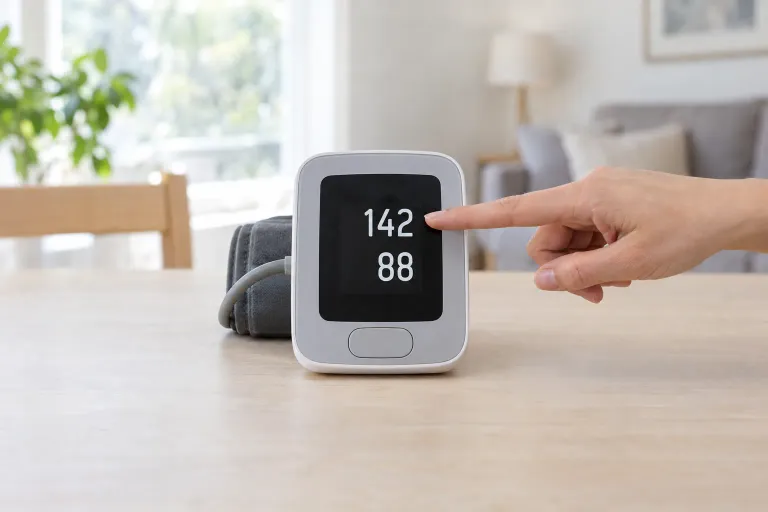
Neither number wins on its own. Whichever one is higher decides the range, so 140/70 and 128/92 both sit above the line even though half of each reading looks fine. After 50 the top number often conveys more information about heart-disease risk, but your log needs both.
What each number measures
The American Heart Association puts it in two sentences. The top number, systolic, “measures the pressure your blood is pushing against your artery walls when the heart beats”. The bottom number, diastolic, “measures the pressure your blood is pushing against your artery walls while the heart muscle rests between beats”.
So the top number is the push, and the bottom number is what never lets go between pushes. They come from the same heartbeat and they do not have to move together.
Why one number is enough
A reading is filed by its worse half. The American Heart Association says plainly that “a higher systolic or diastolic reading may be used to diagnose high blood pressure”, and ESC 2024 works the same way: a reading enters a range as soon as either number reaches that range’s threshold.
The blood pressure calculator on this site follows that rule, which is why a reading with one ordinary number can still come back as elevated or hypertension.
Is 140 over 70 a good blood pressure?
No. At the doctor’s office, 140 is the hypertension line by itself, and a comfortable 70 underneath does not cancel it. A single home reading does not diagnose hypertension, but a home average of 140/70 is above the 135 systolic threshold used for a home average.
A high top number over a settled bottom number is a familiar shape with age. The American Heart Association explains why: as people get older their systolic pressure usually rises because “large arteries become stiffer”. Common, but not a reason to read 140/70 as fine.
When the bottom number is the high one
The same rule, read from the other side. A diastolic reading of 90 or more at the doctor’s office, or a home average with diastolic pressure of 85 or more, reaches the hypertension threshold even when the top number looks unremarkable. Between 70 and those lines, ESC 2024 calls the result elevated only while the systolic value remains below its own hypertension threshold.
So a reading of 128/92 is not a normal reading with an odd detail. It is a reading above the line, and it belongs in the log with the rest.
Why both numbers matter to the doctor
The doctor reads both. The American Heart Association notes that “the systolic blood pressure tells more about risk factors for heart disease for people over 50”. That makes the systolic value especially informative after 50, but it does not make the diastolic value optional at any age.
None of that changes what a diagnosis needs. NICE NG136 confirms hypertension only when both settings meet their condition: clinic systolic pressure is 140 or higher or clinic diastolic pressure is 90 or higher, and the daytime ambulatory or home average has systolic pressure of 135 or higher or diastolic pressure of 85 or higher. That is a statement about the outside-clinic average, not the worst line in your diary.
What this changes in your log
Write both numbers every time, even when one of them looks boring. Add the time and your pulse. Then average the week rather than staring at the highest row: the average blood pressure calculator does the arithmetic and names the range the average falls in.
A single high reading is not an immediate cause for alarm, as the American Heart Association puts it. Sit for a minute, measure again, and write that down too. How to keep a blood pressure log covers the week your doctor is asking for, and the printable blood pressure log has the columns ready.
One exception overrides all of this: systolic pressure above 180 or diastolic pressure above 120, together with chest pain, shortness of breath, back pain, numbness, weakness, a change in vision or difficulty speaking, means calling emergency services instead of making a diary entry.
BP Diary keeps both blood pressure numbers with their date and time. Add notes, follow your history and print or share a report for the dates you choose.