
Why blood pressure readings change through the day
Blood pressure changes with time and circumstances. Learn what can affect it in the half hour before a reading, why clinic and home values differ, and how to compare a series.
Updated 4 min read
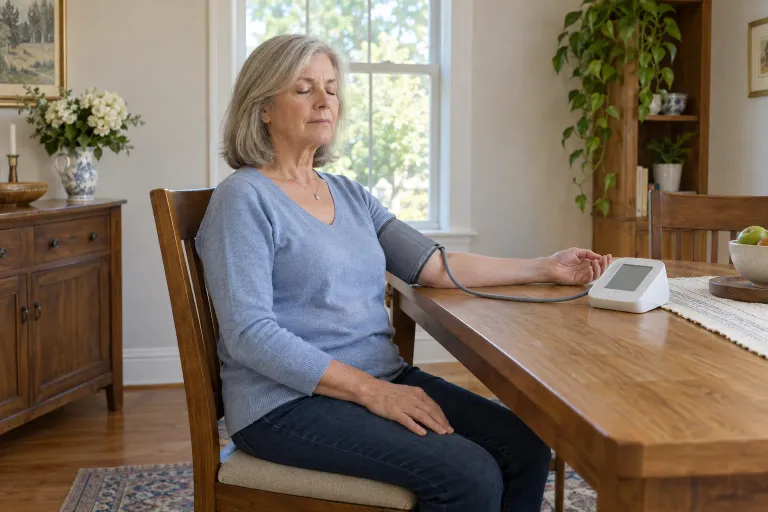
Blood pressure changes through the day. It often climbs when you wake, sits higher at work, settles at home and falls lowest in sleep. Two readings taken a minute apart can differ even when both were taken correctly. A consistent series and its average are usually more useful for routine interpretation than one reading, but severe symptoms or repeated values above an urgent threshold can require prompt care.
The daily pattern
MedlinePlus, the health site of the US National Library of Medicine, describes an ordinary day in one line: “It is normal for your blood pressure to be different at different times of the day.” It is usually higher at work, drops slightly at home and is lowest during sleep.
Waking has its own step. MedlinePlus notes that blood pressure normally increases suddenly when you wake up, which is one reason a morning reading and an evening reading are recorded separately rather than blended together.
The half hour before the reading
What happened in the preceding half hour can affect a home reading. The American Heart Association asks for no smoking, no caffeine and no exercise within 30 minutes, an empty bladder, and at least five minutes of quiet rest with no talking and no phone.
A conversation during the measurement, a full bladder or the stairs you climbed on the way in can make the result harder to compare with a resting reading. How to check blood pressure at home has the full routine.
Why the second reading differs from the first
Because two consecutive readings are two different moments, and clinicians expect that. NICE NG136 tells doctors to take a second measurement during the consultation and, when it is substantially different from the first, a third, then record the lower of the last two.
At home the equivalent is the AHA’s rule: two readings one minute apart, both written down. The second is not a correction of the first. Together they are one recording.
Why the doctor’s number differs from yours
Two named patterns explain some clinic-to-home differences. NICE defines the white-coat effect as a gap of more than 20/10 mmHg between the clinic reading and the average daytime ambulatory or home reading. Masked hypertension means the clinic reading is below 140/90 while readings outside the clinic are higher; its definition does not require the same 20/10 gap.
These patterns show why a clinician may compare readings from both places instead of interpreting either setting alone.
What actually counts
Follow the schedule your clinician gives you or the guidance that applies where you live. For UK adults using home readings to confirm hypertension, NICE asks for two readings a minute apart, twice a day, for at least four days and ideally seven. It discards the first day and averages the rest. In that UK pathway the average is considered with the clinic reading. NICE and ESC 2024 both use 135/85 mmHg as a home-average hypertension threshold, but another local protocol may differ.
An average helps with routine interpretation because it is less dependent on one moment. It does not override severe symptoms or repeated values above an urgent threshold.
The average blood pressure calculator turns a week of rows into that one number and its range. The printable blood pressure log is the sheet to collect them on, with space for the details your doctor needs.
BP Diary keeps each reading with its time and any notes you add. Look back at individual readings and see averages for the period you choose.
When a change is worth a call
Repeat an unexpectedly high reading and record both results. If chest pain, shortness of breath, back pain, numbness, weakness, a change in vision or difficulty speaking accompanies a reading in which systolic pressure is higher than 180 or diastolic pressure is higher than 120, call emergency services without waiting to retest. Without those symptoms, wait at least one minute and measure again. If either value remains above its threshold, contact a healthcare professional immediately.
Numbers alone do not replace urgent assessment of severe symptoms. For readings without those symptoms, the blood pressure calculator shows the selected guideline category and next step.