
Do GLP-1 medicines like Ozempic and Mounjaro lower blood pressure?
How far blood pressure falls in the trials, how quickly, how much heart rate goes up, when blood pressure can drop too low, and what to write down for your GP.
9 min read
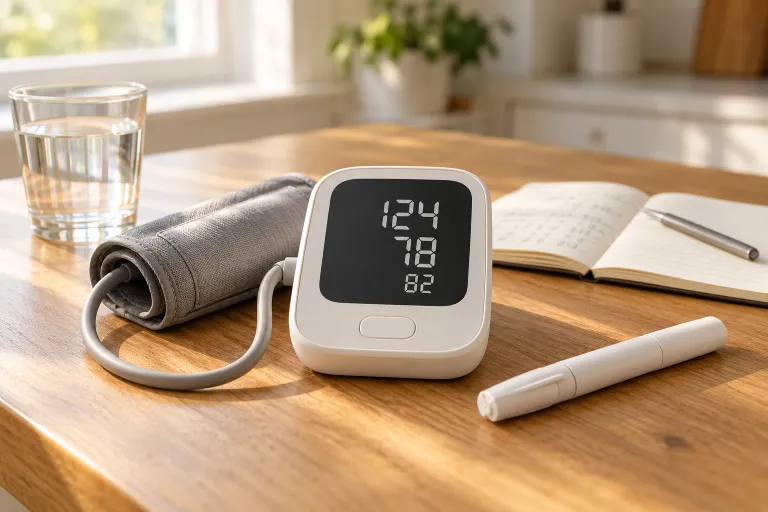
GLP-1 medicines lower blood pressure by a few points on average. In the main weight-loss trials of Wegovy (semaglutide) and tirzepatide (sold in the UK as Mounjaro and in the US as Zepbound), systolic pressure (the top number) fell by about 6 to 8 points (mmHg). On a placebo, a dummy treatment, it fell by about 1 mmHg. In type 2 diabetes trials of semaglutide, the medicine in Ozempic, systolic pressure fell about 2 mmHg more than with placebo or other diabetes medicines. High blood pressure is not among the approved US uses of Ozempic, Wegovy, Mounjaro or Zepbound. Heart rate tends to rise by a few beats per minute, and a small share of people see their blood pressure drop too low. Home readings show your GP how your own numbers change.
How much does blood pressure fall on GLP-1 medicines?
Systolic pressure falls by a few mmHg on average. In the UK, semaglutide is sold as Ozempic for type 2 diabetes and Wegovy for weight management (NHS). Mounjaro contains tirzepatide and is also authorised in the UK for weight management. The table uses US prescribing information, where tirzepatide for weight management is called Zepbound. Tirzepatide also acts on a second hormone receptor, GIP.
| Medicine | Trial | Systolic change |
|---|---|---|
| Wegovy (semaglutide), 2.4 mg weekly injection | STEP 1, 68 weeks: adults with obesity or overweight, without diabetes (Wegovy label) | Fell 6.2 mmHg, versus 1.1 on placebo |
| Zepbound (tirzepatide), 5, 10 or 15 mg weekly injection | SURMOUNT-1, 72 weeks: adults with obesity or overweight, without type 2 diabetes (Zepbound label) | Fell 6.6 to 7.7 mmHg, by dose, versus 1.0 on placebo |
| Zepbound (tirzepatide), 10 or 15 mg weekly injection | SURMOUNT-2, 72 weeks: adults with type 2 diabetes and obesity or overweight (Zepbound label) | Fell 5.6 to 7.1 mmHg, by dose, versus 1.2 on placebo |
| Semaglutide, including Ozempic, as injections or tablets | 29 trials of varied length with 26,985 adults with type 2 diabetes (journal Endocrine, 2023) | Fell 2.3 mmHg more than with placebo or other diabetes medicines |
These results come from different studies and cannot show which medicine lowers blood pressure more. The weight-loss trials measured blood pressure at clinic visits. At the start, average systolic pressure in these trials was between about 123 and 131 mmHg. Diastolic pressure (the bottom number) changed less: in STEP 1 it fell 2.8 mmHg, versus 0.4 on placebo.
A SURMOUNT-1 substudy used day-and-night monitoring in adults without type 2 diabetes. After 36 weeks, average systolic pressure over 24 hours fell 7.4 to 10.6 mmHg more on tirzepatide than on placebo, depending on dose. It fell by day and night, according to a 2024 report in the journal Hypertension.
How quickly does blood pressure fall on GLP-1 medicines?
In SURMOUNT-1, a weight-loss trial of tirzepatide (Mounjaro in the UK, Zepbound in the US), blood pressure fell quickly for about the first 24 weeks, close to six months, and then held steady through week 72, according to an analysis in the journal Heart in 2024. The authors estimated that weight loss explained about two thirds (67.6%) of the fall in systolic pressure. Participants who took blood pressure medicine kept taking it, and trial doctors could adjust it.
Can GLP-1 medicines raise blood pressure?
In the trials, GLP-1 medicines did not raise blood pressure on average. Heart rate, which many home monitors label “Pulse”, is the number that went up: the US prescribing information for Ozempic, Wegovy, Mounjaro and Zepbound reports average increases of 1 to 4 beats per minute. The US Wegovy label asks patients to tell their healthcare professional about palpitations or a racing heartbeat at rest.
Blood pressure can rise again after treatment ends. In SURMOUNT-4, systolic pressure first fell 11.2 mmHg over 36 weeks on Zepbound. People who then switched to placebo saw it rise 8.2 mmHg over the next 52 weeks, versus 2.0 mmHg for those who stayed on Zepbound, according to the Zepbound label.
If a reading is higher than usual, the American Heart Association (AHA) advises measuring again and writing down both. If the top number is suddenly above 180 or the bottom number above 120, and you have no symptoms, it advises waiting at least a minute and measuring again. If either number is still that high, contact your healthcare professional immediately. Call 999 without waiting if either number is that high and you have chest pain, shortness of breath, back pain, numbness, weakness, vision changes or trouble speaking.
Can GLP-1 medicines cause low blood pressure?
Yes, GLP-1 medicines can cause low blood pressure in a small share of people. The US prescribing information for Wegovy reports low blood pressure in 1.3% of adults on Wegovy in its weight-loss trials, versus 0.4% on placebo. The US Zepbound label reports it in 1.6%, versus 0.1% on placebo. These percentages describe trial participants, rather than home readings. Both labels report it more often in people who also took blood pressure medicine. On Zepbound, that was 2.2% of people taking blood pressure medicine, versus 1.2% of people who were not. The Zepbound label also links it to stomach side effects and dehydration.
If you are vomiting or have diarrhoea, the UK’s National Health Service (NHS) advises drinking plenty of fluids, and getting urgent medical advice if you keep vomiting and cannot keep fluids down.
A study presented at ENDO 2026, the Endocrine Society’s annual meeting, looked back at records of 42,262 adults who already took at least two kinds of blood pressure medicine. In this group, the share who had an episode linked to low blood pressure rose from 8.7% before they started a GLP-1 medicine to 10.2% in the six months after. Episodes included dizziness, fainting, falls, diagnoses of low blood pressure and systolic readings of 90 or below. They were most common in people aged 65 and older and in people with type 2 diabetes. Unlike the trials in the labels, the study had no placebo group and is so far only a conference abstract, so it shows a link, not proof that the medicine caused the episodes. The study’s senior author says more studies are needed, as Northwestern University reported.
The NHS and the AHA both call a reading below 90/60 low. The AHA says one low reading is usually not a cause for alarm unless you have symptoms or other problems, and advises contacting your healthcare professional if you are dizzy, nauseous or have other symptoms. The NHS lists light-headedness or dizziness, nausea, blurred vision, feeling weak, confusion and fainting. If you feel faint, the NHS advises lying down with your legs raised or, if you cannot, sitting with your head lowered between your knees. Read more about low blood pressure readings.
Dizziness is not always low blood pressure. The NHS pages on tirzepatide and semaglutide list low blood sugar as a side effect that can make you feel dizzy. Low blood sugar is more likely if you also take other diabetes medicines.
What to record at home on a GLP-1 medicine
Write down each reading with its date, time and heart rate. The AHA says to ask your healthcare professional how often to measure. It also explains how: rest quietly for five minutes, take two readings one minute apart, and measure at the same time every day.
Alongside the numbers, note: the day you started the medicine or changed the dose; the day of each injection; days with nausea, vomiting or diarrhoea; and any dizziness, with the time it happened.
This record matters most if you also take blood pressure medicine. The AHA says not to stop taking blood pressure medicine without checking with your healthcare professional, whatever your readings show. Your prescribing doctor decides whether any dose should change, using your readings to inform that decision.
The average blood pressure calculator takes a list of readings and gives their average. The printable blood pressure log has a notes column if you prefer paper. BP Diary keeps each reading with its heart rate and your note, and makes a free report for any period you choose, such as the weeks since your last dose change.
When to contact your GP
Contact your GP if you keep having dizzy spells, which the NHS describes as a symptom of low blood pressure. The NHS also advises seeing a GP after any fainting episode. Call 999 at once if someone who has fainted is not breathing, cannot be woken within a minute, has not fully recovered or has trouble speaking or moving. Do the same if they have chest pain or a pounding, fluttering or irregular heartbeat. The NHS lists other emergency signs, such as fainting while exercising or lying down. Bring your record to appointments so your GP can see what has changed since you started the medicine.